
For more than a decade, drones have transformed industries, from aerial photography and land surveying to agriculture and emergency response. Yet despite their impressive capabilities, most commercial drone operations remain confined to a major limitation: they must stay within the pilot’s visual line of sight (VLOS).
This rule has historically kept drone use cautious and contained. Under VLOS rules, drones are typically restricted to about 500 m from the pilot, forcing frequent relocations and limiting efficiency. EVLOS extends range slightly by adding visual observers, but this approach scales poorly and increases costs.
That’s where Beyond Visual Line of Sight (BVLOS) operations come in. BVLOS represents the next leap forward, a shift that promises to unlock the true economic, operational, and societal potential of uncrewed aircraft systems (UAS).
The global BVLOS market—valued at around USD 1.2–1.4 billion in 2024–2025 and projected to grow at an annual rate of 20–26%—is poised to exceed USD 4–12 billion by the early 2030s. This momentum reflects not just technological advancement in AI and detect-and-avoid systems, but also regulatory shifts that are breaking BVLOS free from its historical shackles, according to analysts (GMI)
What Is BVLOS?
Beyond Visual Line of Sight refers to drone operations conducted at distances or altitudes where the remote pilot can no longer visually see the aircraft without technology aids.
Instead, BVLOS flights rely on:
- Advanced navigation and sensing systems
- Ground control stations
- Real-time communication links
- Detect-and-avoid (DAA) systems
- Airspace monitoring tools
When these pieces work together, drones can safely fly far beyond the operator’s position, even over miles of terrain.
Why BVLOS Matters
Keeping drones within visual sight severely limits their range, efficiency, and economic value.
Here’s what wider BVLOS adoption makes possible:
1. Long-Range Inspections
Industries like utilities, oil and gas, and rail transport can inspect miles of pipelines, power lines, or tracks without repositioning crews.
2. Scalable Delivery Services
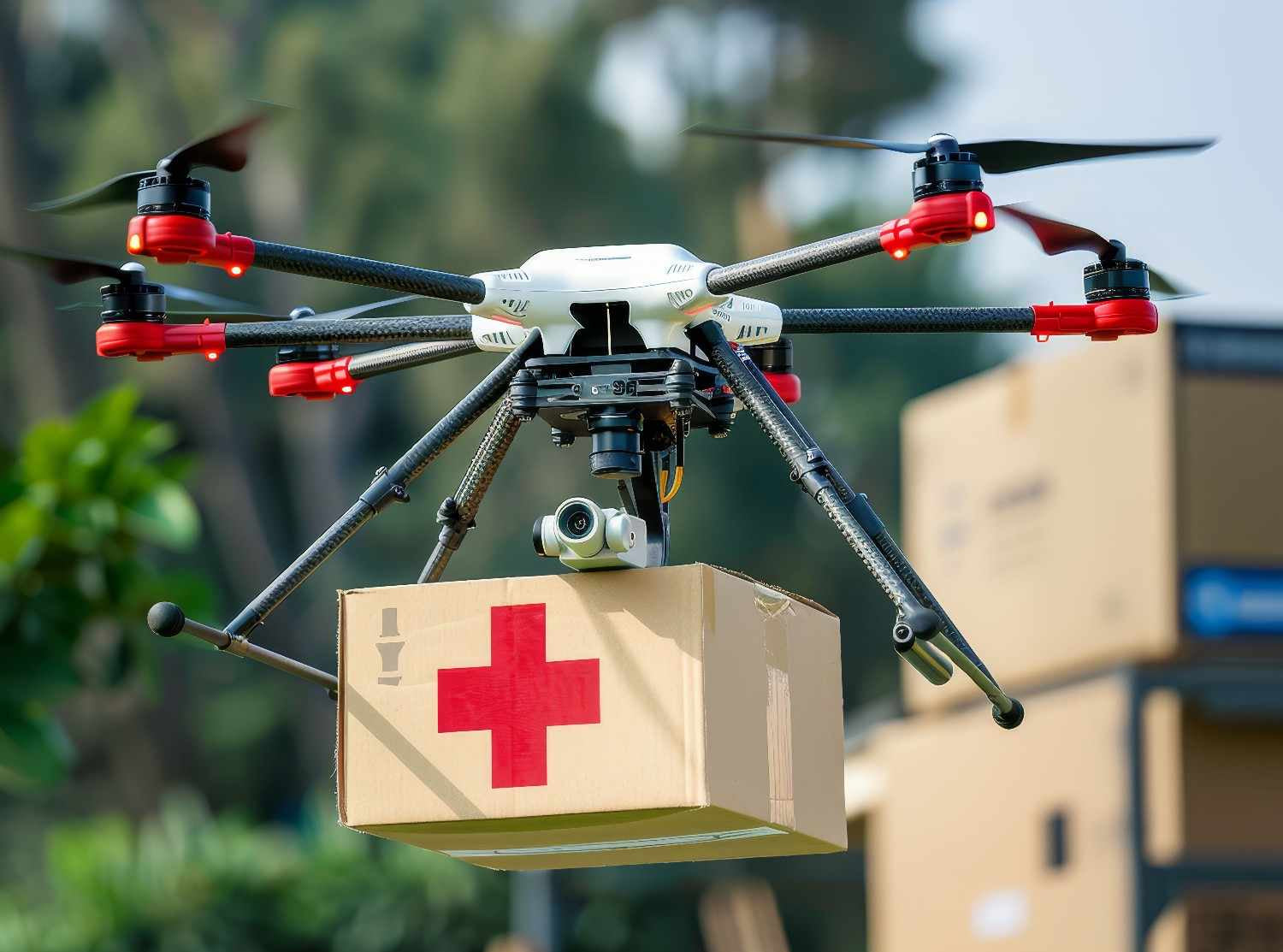
Package delivery becomes feasible only when drones can travel autonomously over long distances and diverse terrain.
3. Precision Agriculture at Scale
Large farms can benefit from continuous crop monitoring, spraying, and mapping without constant human oversight.
4. Disaster Response and Public Safety
BVLOS drones can reach dangerous, remote, or inaccessible areas long before human responders can.
5. Reduced Operational Costs
Fewer crew movements and less manual oversight translate into lower costs and faster operations.
6. Environmental Monitoring and Conservation
BVLOS drones can track wildlife, monitor ecosystems, and support anti-poaching efforts in remote regions.
7. Infrastructure and Smart Cities
Continuous monitoring of bridges, roads, and traffic networks improves urban resilience and safety.
8. Defense and Security Applications
Persistent surveillance and rapid deployment in contested or inaccessible areas enhance national security.
The Technology Behind BVLOS
Successfully operating BVLOS requires a tightly integrated ecosystem of sensors, communication modules, and automation technologies that guarantees both aircraft safety and airspace safety. These components are not optional—they are the foundation for regulatory approval and operational scalability.
Key enablers include:
1. Detect-and-Avoid (DAA) Systems
Critical for collision prevention, DAA uses onboard sensors and algorithms to identify other aircraft, obstacles, and hazards; then autonomously adjust flight paths. This capability is central to meeting safety standards set by regulators.
2. Reliable Command and Control (C2) Links
BVLOS depends on uninterrupted communication between the drone and ground station. Redundant links using LTE/5G or satellite connectivity ensure resilience against signal loss, which is a major operational risk.
3. Autonomous Flight Capabilities
Beyond manual control, BVLOS drones must handle:
- Dynamic route planning
- Real-time adjustments for weather or traffic
- Fail-safe emergency behavior
- Autonomous landing protocols
4. Ground-Based Surveillance Systems
Radar, ADS-B receivers, and Uncrewed Traffic Management (UTM) systems provide situational awareness and airspace coordination, enabling BVLOS flights to coexist safely with crewed aviation.
Emerging Technologies to Watch:
- Edge AI for onboard decision-making
- Cloud-based fleet management platforms
- Cybersecurity layers for C2 and data integrity
- Integration with Remote ID systems for compliance
The Regulatory Challenge
While BVLOS technology is rapidly advancing, regulations have been slow to catch up.
In many countries, including the U.S., BVLOS operations require special waivers. Agencies such as the FAA are working on frameworks to integrate BVLOS flights safely into the national airspace.
United States: BVLOS flights currently require FAA waivers under Part 107 (§107.31), though these are transitioning toward a standardized framework under the proposed Part 108 rule. This will allow two approval pathways—permits for lower-risk operations and certificates for larger-scale or higher-risk missions—supported by mandatory safety measures like Remote ID, DAA, and UTM integration.
United Kingdom: Operators must secure an Operational Authorisation from the CAA to fly BVLOS. As part of its “Future of Flight” roadmap, the CAA expects routine BVLOS missions—initially in segregated airspace—to be fully integrated with crewed aircraft by 2027.
Europe (EASA): BVLOS falls under the ‘specific’ category in EU Reg. 2019/947, requiring risk-based SORA assessments or use of STS/PDRA approaches. In mid-2020, EASA published an NPA introducing updated compliance standards for BVLOS operations over populated areas, aimed at harmonizing authorizations across member states
Key regulatory considerations include:
- Air risk and ground risk assessments
- Shielded operations
- DAA performance standards
- Remote ID compliance
- Pilot certification requirements
Despite challenges, momentum is building. Pilot programs and industry partnerships are paving the way for standardized BVLOS rules.
Industries Poised to Benefit Most
Certain sectors stand to see massive transformation once BVLOS becomes mainstream:
Energy & Utilities
Routine inspections across hundreds of miles become automated and cheaper.
Agriculture
Field-scale imaging, planting, spraying, and livestock monitoring become continuous workflows.
Logistics
Drone delivery becomes feasible for rural areas, medical shipments, and high-urgency deliveries.
Smart Cities & Infrastructure
Drones can monitor traffic, inspect bridges, manage congestion, and support emergency services without constant pilot oversight.
Environmental & Wildlife Protection
Remote ecosystem surveys and anti-poaching monitoring have become more effective and less invasive.
The Road Ahead
BVLOS is not just a technological upgrade, it's a paradigm shift. As regulations evolve and technology matures, drones will evolve from niche tools into critical infrastructure for logistics, security, and smart ecosystems.
Industry associations such as AUVSI in the United States, ARPAS-UK in the United Kingdom, Drone Alliance Europe (DAE) and UAV DACH in Europe and the global forum Joint Authorities for Rulemaking on Uncrewed Systems (JARUS) are working to ensure that safety standards are upheld while enabling timely BVLOS adoption across sectors. Their collaboration with regulators is essential to harmonize frameworks and accelerate integration without compromising risk management.
In the coming years, expect to see:
- Standardized BVLOS regulations
- Wider adoption of autonomous drone fleets
- Integration with AI for real-time analytics
- More resilient communication networks
- Large-scale deployment in logistics and infrastructure
BVLOS is the gateway to unlocking the full value of drones. The future of uncrewed flight isn’t just farther, it’s smarter, safer, and more connected.
Share:
Inside America’s Plan to Transform Warfare, Unleashing Drone Dominance
FCC’s Covered List Expansion: A Watershed Moment for the U.S. Drone Industry