
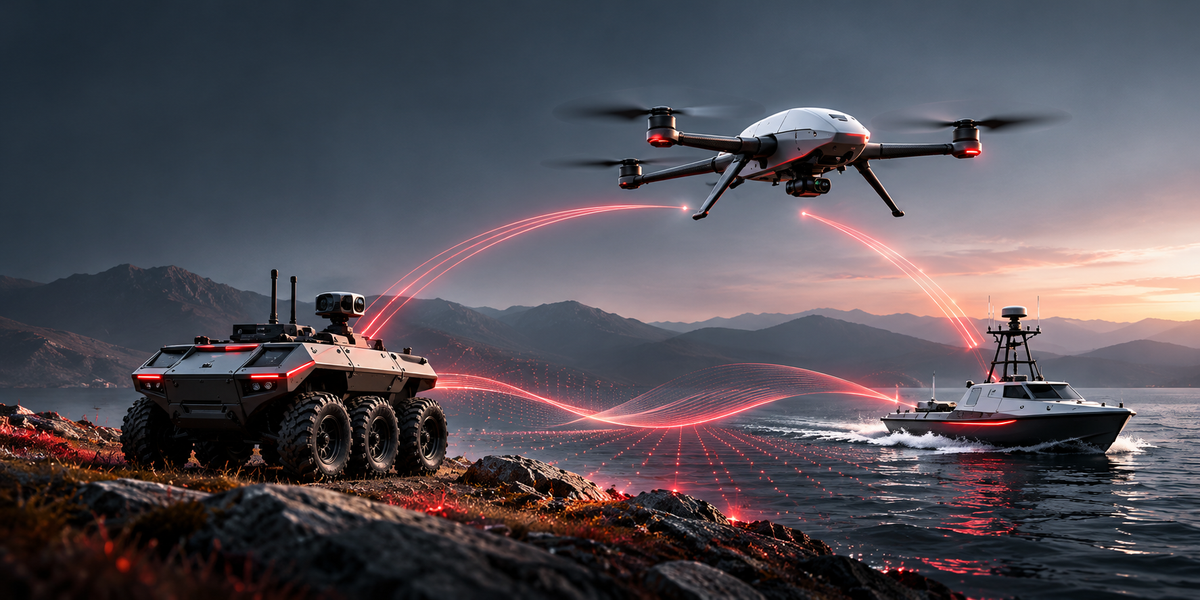
As unmanned systems become more capable, the challenges facing platform designers are changing. Performance is no longer defined solely by the quality of an individual motor, battery or controller. Instead, success increasingly depends on how effectively every element of the propulsion system works together.
Whether developing a UAV, UGV or autonomous maritime platform, OEMs face a common challenge. Platforms must carry more sensors, process more data, support greater levels of autonomy and operate for longer periods, all while maintaining reliability in increasingly demanding environments.
Traditionally, propulsion systems have been assembled from a collection of specialist components sourced from multiple suppliers. A motor may come from one manufacturer, the controller from another, while batteries, communications hardware and software platforms are selected independently. Although this approach offers flexibility, it often creates significant integration challenges that consume engineering resources and introduce risk.
The result is that many development teams spend as much time making components work together as they do optimizing overall vehicle performance.
This is why ePropelled’s Unified Propulsion Architecture is becoming increasingly interesting to the unmanned vehicle industry.
Moving Beyond the Motor
Electric propulsion is often discussed in terms of motors. Yet a motor never operates in isolation. Performance is influenced by the motor controller, matching propeller dimensions, inverter technology, power electronics, thermal management systems, communications architecture, and software environment surrounding it.
A highly efficient motor paired with an unsuitable controller and connected to an undersized propeller may never achieve its full potential. Similarly, advanced power electronics can be constrained by poor thermal integration or software that cannot fully exploit available performance.
The most effective unmanned platforms therefore begin with architecture rather than components.
At ePropelled, this philosophy has led to the development of eP Unified Architecture™, which brings together three important ePropelled technologies:
- ePConnect™: Real-time monitoring, diagnostics and intelligent management of power and propulsion systems.
- ePLink™: Connecting propulsion, power electronics and vehicle control systems for better communication and coordination.
- ePOmniSim™: ePropelled’s evolving software and vision for a complete engineering simulation environment that allows engineers to design, simulate, test and optimize Unmanned Systems before building physical prototypes.
Combining ePUA™ with motors, controllers and power electronics enables engineers designing a complete UAV, UGV, USV or UUV in software, creating its digital twin, selecting motors, generators, batteries and controllers, and simulating how the vehicle will perform under different operating and mission conditions. Instead of optimizing individual subsystems, the entire propulsion chain is designed and validated as an integrated solution.
Why Integration Matters
For many OEMs, integration has become one of the largest hidden costs in platform development.
Every additional supplier interface introduces complexity. Communications protocols must be validated. Thermal interactions must be understood. Firmware must be tested against multiple hardware configurations. Problems often emerge not from individual components but from the interfaces between them.
When systems are designed together from the outset, many of these challenges disappear.
Engineers can build the prototype, test it, compare the actual results with the digital twin, improve the design and repeat.
This approach can dramatically reduce development time, engineering costs and the number of physical prototypes needed.
The outcome is not only a reduction in engineering effort. It is often a measurable improvement in efficiency, reliability and operational performance.
From Hardware to Software-Defined Propulsion
Perhaps the most significant shift now occurring across the unmanned systems sector is the transition from static hardware platforms to software-defined capability.
Historically, propulsion systems were largely fixed once deployed. Performance characteristics were established during design and changed little throughout operational life.
That model is now evolving.
With technologies such as ePLink™ and ePConnect™, propulsion systems can increasingly receive firmware updates, support advanced diagnostics and provide richer operational data throughout their lifecycle, providing through life support for end use operators.
Just as modern smartphones receive new capabilities through software updates, future propulsion systems will continue to improve after deployment.
This creates opportunities for performance optimization, predictive maintenance and enhanced mission flexibility without requiring changes to physical hardware. Platforms can evolve at a faster pace than hardware alone allows.
Data Is Becoming Part of the Propulsion System
As fleets of autonomous vehicles grow, operators require more than just propulsion performance. They require insight.
Today's propulsion systems generate valuable operational information, including energy consumption, thermal behaviour, mission utilisation and component health. When connected through an intelligent architecture, that information becomes a strategic asset.
As vehicles become increasingly software-defined, the ability of management systems to understand the health, status and operating characteristics of propulsion hardware becomes increasingly important. The closer the integration between hardware and software, the greater the opportunity to optimize performance across an entire fleet.
Fleet managers can identify maintenance requirements before failures occur. Operators can optimize mission planning based on real vehicle performance. Manufacturers can gain deeper understanding of system behaviour across large deployed fleets and across multiple domains.
In this environment, propulsion is no longer simply responsible for movement. It becomes an important contributor to operational intelligence.
One Architecture. Multiple Platforms.
A further advantage of unified architectures is scalability.
Many manufacturers operate across multiple vehicle categories, from compact autonomous platforms through to heavy-lift systems. Developing separate propulsion ecosystems for each program can be expensive and difficult to maintain.
The eP Unified Architecture™ addresses this challenge through three scalable platform families:
- Falcon™ is designed for medium-sized UAVs, hybrid-electric applications and advanced aerospace platforms requiring greater continuous power and sophisticated energy management.
- Hercules™ delivers high-power capabilities for heavy-lift UAVs, defense applications, marine propulsion and industrial electrification programs operating in demanding environments.
- Rhino™ Ground Propulsion Motors are developed to deliver high torque with fine control for UGVs from agriculture to security and defense applications.

Although optimized for different missions, power levels and even domains, all three platforms share a common architectural foundation, simplifying integration, support and future technology evolution.
The Future Is Architectural
As autonomy matures across air, land and maritime sectors, propulsion will increasingly be judged not by performance specifications alone, but by how effectively it contributes to overall mission success.
Range, endurance, reliability, maintainability, operational intelligence and through life support are becoming as important as power and torque.
The industry's direction is clear. The future belongs to propulsion ecosystems rather than individual components.
For OEMs seeking to accelerate development while reducing integration risk, unified architecture offers a compelling path forward.
Because in next-generation unmanned systems, performance does not begin with a motor.
It begins with architecture.
Author Bio

Author: Robert Boothby, CTO Software and Intelligence, ePropelled
Robert Boothby brings to ePropelled more than 25 years of experience in software engineering leadership, architecting complex systems, and driving transformation across multiple technology domains. Robert has spent the past decade working at VocaLink on innovative payment technologies and at NatWest Group on building two cutting-edge banking cores.
Teilen:
Warum untersuchen wir das Scheitern sorgfältiger als den Erfolg?