
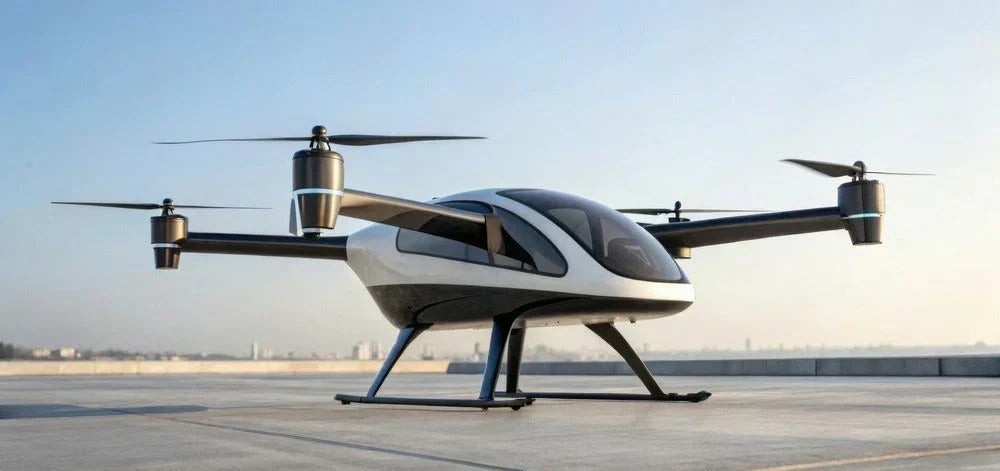
Les systèmes de propulsion électrique sont le cœur battant des véhicules aériens sans pilote (UAV) modernes. Des quadricoptères légers aux drones à voilure fixe de longue endurance, l’efficacité de la propulsion détermine directement la durée pendant laquelle un drone peut rester en vol et la charge utile qu’il peut transporter.
Au centre de ce système se trouve un composant d’une simplicité trompeuse : le moteur électrique. Son choix de conception, son couple, son efficacité, sa taille et son comportement thermique se traduisent par des différences de performances réelles qui peuvent faire ou défaire une mission.
Nous explorons ici comment la conception du moteur influence le temps de vol et la capacité de charge utile, et ce que les concepteurs d'UAV devraient prendre en compte lors de la sélection ou de l'optimisation des systèmes de propulsion électrique.
Le rôle des moteurs électriques dans la propulsion des drones
Un système de propulsion électrique se compose généralement de :
- Moteur électrique
- Contrôleur de vitesse électronique (ESC)
- Hélice
- Source d'alimentation (généralement des piles au lithium)
Bien que tous les composants soient importants, le moteur définit l’enveloppe de fonctionnement de l’ensemble du système. Il détermine l’efficacité avec laquelle l’énergie électrique est convertie en énergie mécanique produisant une poussée.
Un moteur mal adapté peut gaspiller de l’énergie, surchauffer ou limiter la poussée, même si la batterie et l’hélice sont bien choisies.
Efficacité du moteur : la clé d’un temps de vol plus long
Pertes électriques et mécaniques
Le rendement du moteur est principalement affecté par :
- Pertes de cuivre (résistance dans les enroulements)
- Pertes de fer (hystérésis du noyau et courants de Foucault)
- Pertes mécaniques (roulements, friction)
- Pertes de commutation (interaction avec ESC)
Les moteurs de meilleure qualité réduisent ces pertes grâce à :
- Bobinages en cuivre de haute pureté
- Noyaux magnétiques laminés ou optimisés
- Roulements de précision
- Tolérances de fabrication plus strictes
Même une amélioration de 5 à 10 % de l’efficacité du moteur peut se traduire par plusieurs minutes de vol supplémentaires, en particulier pour les drones axés sur l’endurance.
Fonctionnement proche de l’efficacité maximale
Les moteurs sont plus efficaces dans une plage de régime et de couple spécifique. Si un drone fonctionne systématiquement en dehors de cette plage, en raison d'un dimensionnement incorrect de l'hélice ou d'une inadéquation de tension, l'énergie est gaspillée sous forme de chaleur au lieu de poussée.
Couple, valeur nominale KV et capacité de charge utile
Comprendre la cote KV
La valeur KV indique la vitesse à laquelle un moteur tourne par volt (RPM/V) :
- Moteurs à faible KV → couple plus élevé, hélices plus grandes
- Moteurs à KV élevé → RPM plus élevé, hélices plus petites
Pour les drones à charge utile lourde :
- Les moteurs à faible KV associés à de grandes hélices génèrent plus de poussée à un régime inférieur
- Cela améliore la capacité de levage et l'efficacité sous charge
Pour les drones légers ou de course :
- Les moteurs à KV élevé privilégient la réactivité plutôt que l'efficacité
Le couple compte plus que la puissance brute
La capacité de charge utile est limitée par la poussée que le système de propulsion peut générer sans dépasser les limites thermiques ou électriques. Un moteur avec un couple insuffisant :
- Tirer un courant excessif
- Chauffer rapidement
- Réduire l’efficacité et le temps de vol
Les conceptions de moteurs à couple élevé permettent aux drones de soulever des charges utiles plus lourdes sans augmenter considérablement la consommation d'énergie.
Compromis entre poids et performances
La masse du moteur soustrait directement la charge utile disponible. Cependant, plus léger n’est pas toujours mieux.
Moteurs légers
Avantages
- Masse globale inférieure du drone
- Accélération plus rapide
Inconvénients
- Capacité thermique inférieure
- Capacité de poussée soutenue réduite
Moteurs plus lourds et robustes
Avantages
- Meilleure dissipation de la chaleur
- Puissances nominales continues plus élevées
- Fiabilité améliorée sous charge
Inconvénients
- Allocation de charge utile réduite
Pour les missions de longue endurance ou critiques en termes de charge utile, des moteurs légèrement plus lourds entraînent souvent des gains de performances nets en permettant un fonctionnement plus efficace et plus soutenu.
Conception thermique et vol soutenu
La chaleur est l’ennemi silencieux de la propulsion électrique.
Pendant que les moteurs chauffent :
- La résistance électrique augmente
- Chutes d’efficacité
- Les ESC peuvent limiter le courant
- Des dommages permanents deviennent possibles
Les conceptions avancées de moteurs améliorent les performances thermiques grâce à :
- Meilleures voies de circulation de l'air
- Isolation résistante à la chaleur
- Stators plus grands avec une densité de courant plus faible
Un moteur qui tourne plus froid peut fonctionner plus près de son point d’efficacité optimal pendant des périodes plus longues, ce qui est essentiel pour les drones de surveillance, de cartographie et de livraison.
Faire correspondre la conception du moteur au profil de la mission
Il n’existe pas de « meilleur » moteur universel, seulement le meilleur moteur pour une mission spécifique.
| Type de mission | Caractéristiques du moteur |
|---|---|
| Longue endurance | Haute efficacité, faible KV, grandes hélices |
| Charge utile lourde | Couple élevé, conception thermique robuste |
| Course / agilité | KV élevé, faible inertie |
| Drones VTOL | Couple équilibré, refroidissement puissant |
La conception réussie d’une propulsion d’UAV prend toujours en compte l’ensemble du système, et pas seulement les composants individuels.
La conception du moteur a un impact profond à la fois sur le temps de vol et sur la capacité de charge utile des drones électriques. En comprenant comment l’efficacité, le couple, le comportement thermique et le poids interagissent, les concepteurs peuvent extraire beaucoup plus de performances d’une même batterie et d’une même cellule.
À mesure que la technologie des batteries s’améliore progressivement, l’optimisation du moteur et de la propulsion reste aujourd’hui l’un des leviers les plus puissants pour étendre les capacités des drones.
Share:
L’Europe ascendante : un bastion souverain pour l’innovation sans équipage
La prochaine phase de l'autonomie en Europe