
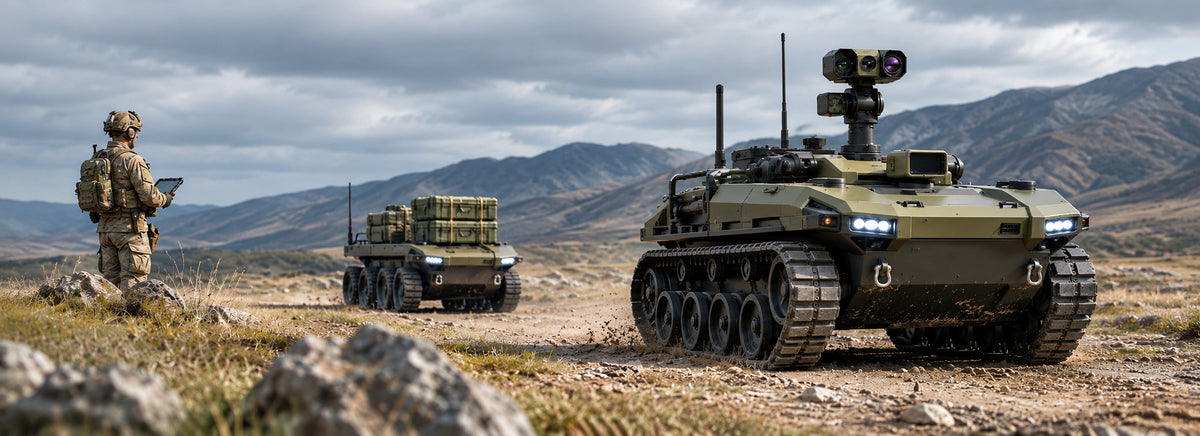
From logistics and casualty evacuation to reconnaissance and combat support, UGVs are reshaping how modern militaries generate combat power while reducing risk to personnel.
For years, the conversation around military unmanned systems centered largely on aircraft. Drones transformed surveillance, reconnaissance, and precision strike capabilities, demonstrating how autonomous technologies could deliver operational advantages while reducing risk to personnel and more expensive platforms.
Today, a similar transformation is underway on the ground.
Unmanned Ground Vehicles (UGVs) are rapidly evolving from specialized equipment into operationally practical battlefield assets. Systems once considered experimental technology are now being deployed for logistics, reconnaissance, mine clearance, casualty evacuation, and combat support. Driven by lessons learned from current conflicts and advances in autonomy, electrification, communications, and sensor technologies, UGVs are becoming an increasingly important component delivering meaningful contributions to force employment.
For defense planners, the attraction is clear. Ground robots can perform hazardous, repetitive, and physically demanding tasks while helping preserve combat power and reduce exposure to enemy threats. Practical instances of UGVs solving problems better than crewed platforms have helped expedite the vision for UGVs in contemporary concepts of operation and employment.
A New Layer of Battlefield Capability
The most prominent value of UGVs lies in their ability to remove personnel from danger - casualty evacuation (CASEVAC).
Traditionally, many military tasks require soldiers to operate in exposed environments. Resupply convoys move through contested terrain. Sappers clear mines and obstacles under fire. Reconnaissance teams maneuver close to enemy positions to gather intelligence. CASEVAC personnel often operate in some of the most dangerous conditions on the battlefield.

UGVs provide commanders with greater operational flexibility. By combining mobility, sensors, secure communications, and increasingly sophisticated autonomous functions, they allow many of these missions to be conducted remotely or with significantly reduced risk to personnel.
Rather than replacing soldiers, UGVs extend their reach, increase their combat load and survivability, and enable maneuver units to accomplish more with available personnel.
Transforming Military Logistics
One of the fastest-growing applications for UGVs is logistics and resupply.
Modern military operations depend on the continuous availability of ammunition, fuel, water, food, medical supplies, and equipment. Delivering these resources to forward positions has always been a vulnerable activity, particularly in environments where supply routes are observed by drones and targeted by precision weapons.
UGVs can help address this challenge by transporting supplies across dangerous routes without placing drivers or support personnel directly in harm's way and augmenting existing supply convoys to add capacity and redundancy.
Whether operating autonomously or under remote control, robotic cargo carriers can perform resupply missions for frontline forces while reducing the risks traditionally associated with resupply operations. As militaries continue to seek ways to improve survivability and operational endurance in contested environments, autonomous logistics has become one of the most compelling use cases for ground robotics.
Casualty Evacuation Without Additional Risk
The recovery of wounded personnel remains one of the most demanding and dangerous battlefield tasks.
Medical personnel and recovery teams frequently expose themselves to enemy observation and fire while attempting to retrieve casualties. Every CASEVAC operation introduces additional risk to both the casualty and those conducting the rescue.
UGVs offer an alternative approach.
Remotely operated evacuation vehicles can enter hazardous areas, retrieve wounded personnel, and transport them out of harm’s way without requiring large recovery teams to enter the danger zone. While these systems will not replace trained medical professionals, they can significantly reduce the risks associated with CASEVAC and improve the speed with which wounded personnel receive treatment at field hospitals or other medical facilities.
As autonomy improves, CASEVAC is likely to become a standard mission set for many military ground robotic platforms.
Intelligence, Surveillance, and Reconnaissance
Information superiority remains one of the decisive factors in modern warfare.
UGVs equipped with electro-optical sensors, thermal imaging systems, electronic-warfare, and communications payloads can provide commanders with critical situational awareness while minimizing risk to personnel. Their ability to operate close to enemy positions makes them particularly valuable in high-threat environments where manned reconnaissance missions may be difficult or impractical.
Electric propulsion systems offer distinct operational advantages for these missions. Their reduced acoustic signatures lower detection, and intelligent power management capabilities dynamically balance platform endurance, and sensor payload demands, giving commanders critical tradespace in both time on station and overall range.
The result is a persistent reconnaissance capability that can extend the reach of military units and improve battlefield decision-making.
Engineering, EOD, and Route Clearance
Explosive Ordnance Disposal (EOD) was one of the earliest military applications for ground robotics, and it remains one of the most important.
UGVs are ideally suited for investigating suspicious objects, clearing obstacles, breaching barriers, and supporting mine-clearing operations. These missions are inherently dangerous, often requiring personnel to operate within range of explosive hazards.
Modern robotic systems equipped with cameras, manipulator arms, sensors, and specialist tools allow operators to perform these tasks remotely while maintaining safe standoff distances.
As the threat posed by mines, improvised explosive devices, and unexploded ordnance continues to evolve, robotic engineering systems are becoming increasingly valuable force protection assets.
Combat Support and Armed UGVs
While logistics and reconnaissance currently dominate many deployments, armed UGVs are attracting growing attention from militaries worldwide.
Remote weapon stations mounted on ground robots can provide overwatch, perimeter security, and fire support while reducing direct exposure of personnel. These systems can be used to monitor critical infrastructure, protect forward operating bases, or support maneuver forces in contested environments.
The concept remains an area of active development, particularly as military organizations examine questions of autonomy, command authority, and rules of engagement. Nevertheless, armed UGVs continue to demonstrate the potential to expand battlefield capability while supporting force protection objectives.
Addressing the Manpower Challenge
Many armed forces face increasing pressure to maintain operational effectiveness while operating within constrained personnel resources.
Recruiting, training, and retaining military personnel has become more challenging in many countries. At the same time, modern military operations continue to place growing demands on available forces.
UGVs offer an opportunity to address part of this challenge by acting as force multipliers.
A robotic platform does not replace a soldier, but it can perform routine transport tasks, support reconnaissance operations, carry equipment, and assume specific high-risk missions. This allows military personnel to focus on activities that require human judgment, leadership, and decision-making.
In an era where military effectiveness is increasingly measured by both capability and capacity, force multiplication has become a powerful driver of UGV adoption.
The Role of Mobility and Power
As military requirements continue to expand, propulsion systems are becoming increasingly important to overall UGV performance.
Modern defense customers are seeking systems capable of carrying greater payloads, operating for longer durations, and supporting increasingly sophisticated sensors and communications equipment. Meeting these requirements requires more than simply adding larger batteries or more powerful motors.
Efficiency, thermal management, reliability, and intelligent power distribution all play central roles in determining mission effectiveness.
This is one reason why integrated propulsion architectures are becoming increasingly attractive. By optimizing motors, controllers, power electronics, and software as a complete system, manufacturers can help maximize endurance, improve reliability, and reduce maintenance requirements across demanding operational environments.
Challenges Still to Be Solved
Despite their rapid progress, UGVs are not a complete substitute for conventional military forces.
Ground vehicles must still navigate difficult terrain, overcome mobility constraints, maintain communications links, and operate effectively in environments increasingly shaped by electronic warfare. Power management, charging infrastructure, and field sustainment also remain important considerations, particularly as unmanned fleets expand.
However, these challenges are driving innovation across the industry. Advances in autonomy, connectivity, resilient communications, and electric propulsion continue to improve operational performance and expand the range of missions UGVs can perform.
Looking Ahead
The evolution of military UGVs mirrors the journey previously taken by unmanned aerial systems. What began as a niche capability is now moving steadily toward mainstream adoption in contemporary military doctrine.
The lessons emerging from today's operational environments are clear. Ground robots can reduce risk, improve logistics, extend reconnaissance capabilities, and increase military effectiveness across a wide range of missions.
As technology continues to mature, UGVs will become an increasingly important element of the future battlefield, not as replacements for soldiers, but as enablers that allow military personnel to operate more effectively, more efficiently, and more safely.
For defense organizations seeking to enhance force readiness, improve survivability, and generate greater operational capability, the age of the unmanned ground vehicle has only just begun.
Several observations within this article are informed by publicly available analysis, military development programs, and operational lessons from contemporary conflicts, including the accelerating adoption of autonomous and unmanned systems across modern armed forces.
References
- NATO, Summary of NATO's Autonomy Implementation Plan
Supports discussion of military adoption of autonomous systems, future force development, and the strategic importance of autonomy in defense. [nato.int] - NATO Science & Technology Organization (STO), Autonomous Technologies
https://www.sto.nato.int/
Supports references to robotics, autonomy, unmanned systems, and future military operating concepts. [sto.nato.int] - NATO STO, Robotics and Autonomous Systems Briefing Paper
https://sto-trends.com/assets/briefing-papers/NATO_STO_2025_Briefing_Paper_2_Robotics_and_Autonomous_Systems.pdf
Supports discussion of UGV applications including logistics, ISR, force protection, combat support, and future battlefield integration. [sto-trends.com] - U.S. Army DEVCOM Ground Vehicle Systems Center (GVSC)
https://gvsc.devcom.army.mil/
Supports references to robotic combat vehicles, human-machine teaming, autonomy, and unmanned ground vehicle development. [gvsc.devcom.army.mil], [devcom.army.mil] - UK Ministry of defense, Land Industrial Strategy
https://www.gov.uk/government/publications/land-industrial-strategy
Supports discussion of future land capabilities, force modernization, autonomy, digitisation, and platform innovation. [gov.uk], [army.mod.uk] - British Army, Future Soldier
https://www.army.mod.uk/media/11826/20210322-army-future_soldier-publication-final.pdf
Supports references to force multiplication, modernization, digitisation, robotics, and autonomous capabilities in future military operations. [army.mod.uk] - Center for Strategic and International Studies (CSIS), Ukraine's Future Vision and Current Capabilities for Waging AI-Enabled Autonomous Warfare
https://www.csis.org/analysis/ukraines-future-vision-and-current-capabilities-waging-ai-enabled-autonomous-warfare
Supports discussion of lessons learned from contemporary conflict, accelerated adoption of autonomous systems, and battlefield innovation. [csis.org], [csis-websi...zonaws.com] - Royal United Services Institute (RUSI), The Future of War: How Autonomous Systems Are Reshaping Conflict
Supports references to the growing role of autonomous platforms and operational lessons emerging from current conflicts. [rusi.org] - Janes, Ukraine's NC13 Plans Expansion of Strike UGV Operations
Provides evidence of real-world deployment and scaling of UGV capabilities in active military operations. [janes.com] - International Institute for Strategic Studies (IISS), Emerging and Disruptive Technologies for Europe's defense
Supports discussion of autonomy, AI, robotics, and their impact on future defense capabilities.
Author Bio

Author: Harry Petrey, Director of Defense Affairs, ePropelled
Harry Petrey brings more than 30 years of experience across the defense, intelligence, and national security sectors. As Director of Defense Affairs at ePropelled, he works with defense customers and industry partners to align emerging operational requirements with advanced power management and electric propulsion technologies for autonomous air, land, and maritime systems.
Share:
Why Unified Architecture Is Becoming the New Standard for Unmanned Vehicle Design