
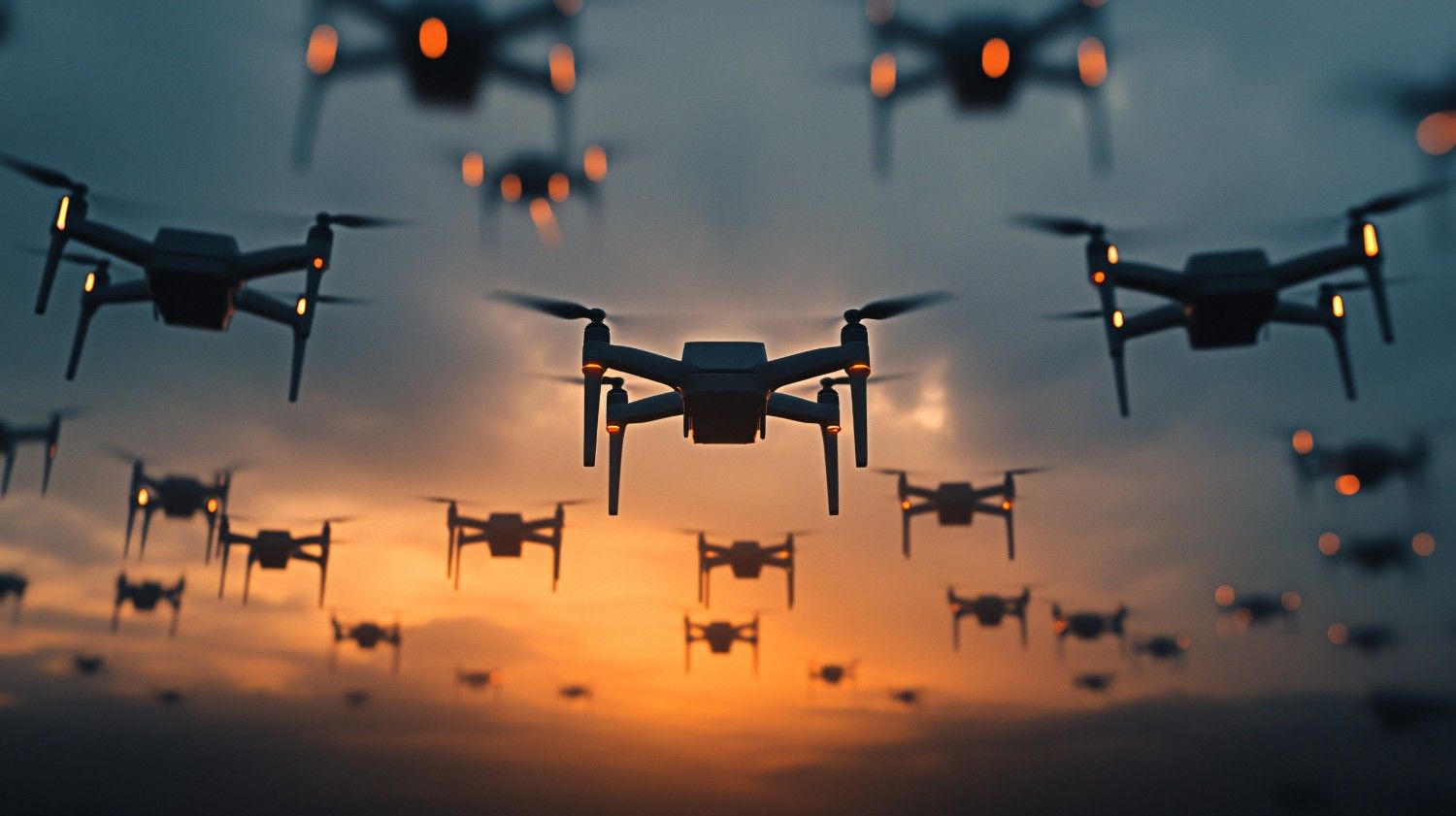
If you’ve been tracking the U.S. military’s recent pivot toward cheap, attritable drones, the Department of War’s (DoW) “Drone Dominance” effort is the clearest signal yet that the Pentagon intends to move from talking about scale to buying at scale, fast.
Here is what the program is, what’s actually happened so far, and what to watch through early 2026.
The Pentagon has named 25 vendors for Phase I of the Drone Dominance Program, with Gauntlet I is scheduled for February 17–18, 2026, at Fort Benning, running into early March, followed by ~$150M in prototype delivery orders.
This first phase begins the competitive cycle aimed at rapidly fielding low-cost, one-way attack uncrewed systems at scale. The announcement reinforces the intent to accelerate procurement cycles and push large quantities of operationally ready systems into the field in the near term.
In the program note accompanying the announcement, Secretary of War Pete Hegseth described the initiative as both a technological and process race, emphasising that the department is committed to buying what works, at speed and without unnecessary delay.
The program continues to highlight the need for scalable production, supply chain resilience and an iterative approach to capability improvement as the United States moves to expand its uncrewed systems inventory.
1) What “Drone Dominance” is trying to do
At its core, Drone Dominance is a mass-fielding plan for low-cost, lethal small UAS, explicitly emphasizing scale, domestic/secure supply chains, and streamlined buying.
The stated ambition is enormous:
- Current public signals point to more than 200,000 small drones by 2027, with some reporting that the total could reach about 340,000, and an initial ~30,000 targeted from Phase I orders. An Army.mil write-up frames it even larger, hundreds of thousands, saying $1B will fund roughly ~340,000 small UAS over about two years.
- Clarity on competition structure. The Gauntlet is not a down-select process. Vendors who are not in Phase I can apply again for later Gauntlets, which are planned on roughly a six-month cadence.
Those numbers aren’t trivial “pilot program” talk. They’re industrial-policy-level targets.
2) The policy groundwork was laid in mid-2025
Drone Dominance didn’t appear out of nowhere. It sits on a stack of executive and DoD-level direction that ramped through 2025:
- The White House issued an executive action titled “Unleashing American Drone Dominance” in June 2025, emphasizing accelerating commercialization, domestic production, and broader integration of UAS capabilities.
- A later DoD memo (summer 2025) reinforced the “unleash dominance” theme from the department side.
In other words: by the time the DoW rolled out a named procurement program, leadership had already spent months setting expectations that drones were moving from “capability niche” to “force-wide baseline.”
3) What “progress” looks like so far (as of Feb 2026)
Because the program is still early, “progress” isn’t best measured in battlefield impact yet, it’s measured in machinery: contracts, timelines, and institutions aligning to execute.
-
The buying mechanism is real, and it’s live
A key sign this isn’t vaporware is that solicitation activity is visible via official procurement channels. A SAM.gov posting for Drone Dominance Program Phase I – Request for Solutions lays out the push for one-way attack (OWA) sUAS, emphasizing low cost, scale, and supply-chain requirements.
-
The “Gauntlet” model is now the center of gravity
Eligibility and preference. While Drone Dominance is open to US and Allied vendors, the department has consistently signaled a preference for US manufacturing using US-made components and materials, in line with the program’s aim to scale a trusted domestic industrial base and reduce reliance on foreign supply chains.
Partnering path for Allied OEMs. For non-US OEMs planning to enter later Gauntlets, partnering with a US manufacturer can de-risk NDAA compliance and speed acceptance. ePropelled, a US manufacturer on the UAS Blue List, can provide a domestic build pathway aligned with these preferences.
UAS Blue List definition. The UAS Blue List is DoD’s vetted catalogue of NDAA-compliant, cyber-secure UAS platforms and components. It transitioned from DIU to DCMA US-X in December 2025 and is being scaled into a trusted marketplace to speed fielding and procurement. Blue-listed status is widely used to streamline government acceptance and reduce risk.
Multiple sources describe a competitive, gated structure: vendors compete in “gauntlets,” winners receive orders, losers fall away. The public program site explicitly references “Prototype Gauntlet events,” with Gauntlet I in Feb 2026 and orders targeted in that event. Industry coverage echoes that this is meant to help suppliers organize around scaling secure, low-cost manufacturing urgently.
-
The defense ecosystem is starting to line up behind it
This matters because drone scale is not just a “cool tech” problem, it’s a production, quality, contracting, and acceptance problem.
- DCMA messaging has highlighted the need for public/private cooperation and resource alignment to hit DoW objectives.
- AUVSI publicly praised the program’s competitive approach and rapid contracting/payment emphasis, arguing it could strengthen industrial base resiliency.
That kind of alignment is what you look for before orders start turning into deliveries.
-
Leadership and org structure are being reshuffled to drive execution
Recent reporting describes “Drone Dominance” as a new Pentagon initiative with a $1.1B congressional backing and a goal of tens of thousands of drones by 2027, tied to broader acquisition streamlining.
Reuters also reported that a Pentagon “DOGE” unit was involved in revamping the drone program, with the thrust being faster procurement and domestic production.
You don’t have to like the politics around it to see the organizational signal: leadership is trying to make drone procurement harder to slow-roll.
4) What happens next (the near-term milestones)
If the program keeps its tempo, the near-term milestones are set.
- Gauntlet I evaluations run Feb–Mar 2026, followed by ~150 million dollars in prototype delivery orders and about five months of deliveries First bulk orders (~30,000) + deliveries targeted by July 2026
- Gauntlet II follows in six months
- Ramp volume into 2027 toward the “hundreds of thousands” ambition
- Each Gauntlet remains an open entry point, not a final elimination, with subsequent Gauntlets expected roughly every six months and larger volumes plus lower unit costs in later phases.
This is where Drone Dominance either becomes the model for “how to buy attritable systems fast” … or becomes another well-branded effort that hits industrial friction.
5) The real risks: what could slow “dominance” down
Even with funding and urgency, the predictable friction points remain:
- Supply-chain integrity at scale (secure NDAA-compliant components, repeatable sourcing, QA). The Blue List handoff to DCMA US-X is intended to help address this by scaling a trusted pipeline.
- Training + doctrine (getting units to use drones routinely, not as a special event)
- Procurement culture (moving from “perfect requirements” to “good enough, iterative, fielded”), which the DoW itself has implicitly acknowledged by emphasizing bureaucratic risk aversion in its framing.
- Testing realism (gauntlets must reflect battlefield constraints, not demo-day conditions)
If you’re evaluating the program’s success, watch less for press releases and more for: delivery cadence, unit adoption, and repeat orders.
Final thoughts
Drone Dominance is no longer just an idea, it now has public timelines, live evaluation events, funding signals, and a competitive field that can scale a low cost UAS industrial base.
The next weeks will show whether Gauntlet scoring turns into on time deliveries and a repeatable pipeline, and whether later Gauntlets truly broaden the field as intended. The direction of travel is clear: openness to US Allied entrants paired with procurement preference for US manufacturing and US made components, in service of a durable domestic supply base for attritable UAS.
Share:
Bridging the Gulf: Uncrewed Innovation and Sovereign Capability in Focus
Drones in Construction and Maintenance: Driving Safety, Accuracy, and Asset Longevity